
In context
Why Memes Misspell On Purpose: Stonks, Smol, and Instant Tone

Published · Last updated
I have moderated enough comment sections to know this: people will forgive a hot take faster than they will forgive a typo. So when memes are full of “wrong” spellings like stonks and smol, it is not because the internet forgot how to spell. It is because misspelling is doing a job.
In meme culture, intentional errors are like stage lighting. They tell you what mood to read the line in: silly, sarcastic, self-aware, affectionate, or quietly brutal. If you miss that cue, you can end up taking a joke literally, and the replies will be unforgiving.
What intentional misspellings signal
Deliberate misspellings in memes are a form of tone markup. They do not change the dictionary meaning as much as they change the vibe of the meaning.
- Distance: “I am not saying this sincerely.”
- Character voice: “Read this like a little gremlin is talking,” or “like a corporate robot,” or “like an overexcited puppy.”
- Play: “We are in joke-mode, not essay-mode.”
- Softening or sharpening: It can make a statement feel cuter and gentler, or more mocking and pointed.
This sits right next to other internet tone tools like irony, deadpan captions, and reaction images. If you want the broader map, my go-to starting point is our piece on irony in internet slang.
“Stonks”: sarcasm with a suit on
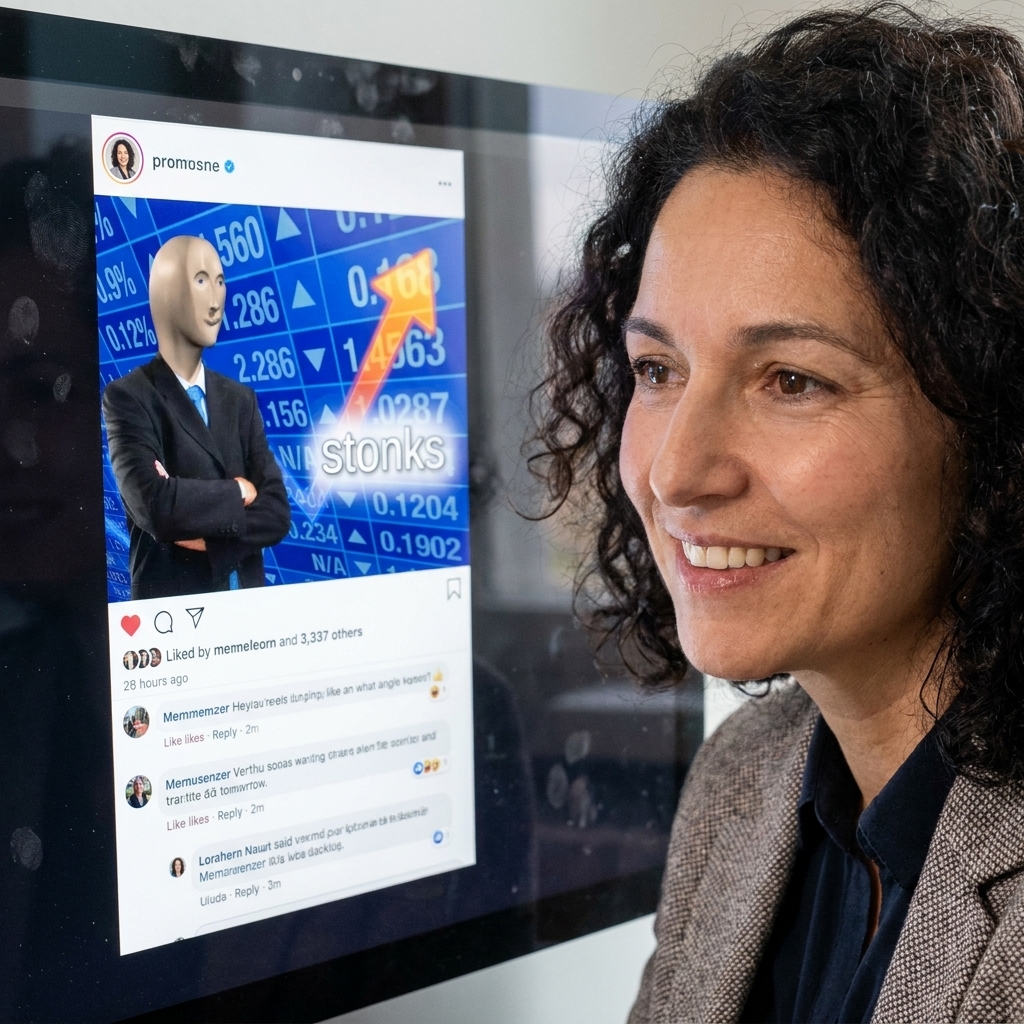
Stonks is the intentionally wrong version of “stocks,” popularized by the “Stonks” meme image of a stiff, suited figure in front of a rising chart. The misspelling is the tell: this is about fake expertise and comically simplified logic.
What “stonks” usually means
- Mocking financial confidence: pretending a bad idea is a genius investment.
- Celebrating a questionable win: “I saved $2 and ruined everything else. Stonks.”
- Pointing at flawed reasoning: calling out a logic leap without writing a whole paragraph.
How the tone works
If someone writes “stocks,” it can sound like real finance talk. “Stonks” tells you: do not take this literally. It is a costume. The speaker is cosplaying a business genius for comedic effect.
Examples in the wild
- “Bought a $60 game to relax and now I am stressed. Stonks.”
- “I walked to the store to save gas and bought eight snacks. Stonks.”
- “I turned off notifications to focus and missed the deadline. Stonks.”
Notice the pattern: a tiny moment framed like a big-brain strategy, with the misspelling doing the eyebrow raise.
“Smol”: cute on purpose
Smol is a cutesy misspelling of “small.” It comes from a long internet tradition of playful “baby talk” spelling, especially in pet posts and wholesome fandom spaces. When someone says “smol,” they are usually shrinking the subject on purpose, emotionally, not physically.

What “smol” usually means
- Affectionate: “I love this tiny thing.”
- Protective: “This is precious and must be safeguarded.”
- Playfully dramatic: acting like something minor is unbearably cute.
Where people get tripped up
“Smol” can be sincere, but it can also be ironic-cute. In the same way you can say “my little guy” about a fully grown friend to be silly, “smol” can be used to poke gentle fun.
Examples in the wild
- “Look at him. A smol lad.”
- “I made one phone call today. I am a smol productivity icon.”
- “This horror game has a smol spider. I will be moving out.”
Misspelling = “read this in a voice”
One reason intentional misspellings spread so fast is that they function like a built-in voice filter. You can practically hear the delivery.
In moderation, I saw the same misunderstanding over and over: someone reads a meme caption in their own serious voice, not the implied meme voice, and suddenly a joke becomes an argument. Phonetic spellings help prevent that by forcing a specific cadence.
- Stonks reads like confident nonsense.
- Smol reads like affection or playful babying.
- Doggo-speak variants (like “heckin,” “pupper”) read like wholesome chaos.
If you are interested in how these forms evolve and then get replaced, our breakdown of the lifecycle of internet slang is the rabbit hole I keep coming back to.
Playful or mean: how to tell
Intentional misspellings are not automatically friendly. The same “I am being silly” flag can also be used as a shield for mockery. Here is what I look at when I am decoding tone quickly.
1) Who is the joke on?
- Self-directed: usually harmless. “I did this dumb thing, stonks.”
- Other-directed: can be teasing or can be cruel, depending on context.
2) Does the post punch down?
“Smol” used for a pet is sweet. “Smol” used to infantilize a real person who is being criticized can be dismissive, especially if the target is already being dogpiled.
3) What else is in the sentence?
Watch for add-ons that sharpen the edge: “bestie,” “sweetie,” “babygirl,” “king,” “girlboss,” or exaggerated politeness. Those can be sincere, but they are also classic sarcasm carriers.
4) What platform are we on?
Every platform has its own default volume knob. A caption style that reads as light teasing on one app can read as harsh on another. If you want a practical way to do context checks, I wrote up a step-by-step in how to work out unfamiliar internet slang.
Common patterns
Not every meme misspelling becomes a Big Term like “stonks.” A lot of it is reusable technique. Here are a few patterns you will see again and again.
Phonetic spellings
- What it looks like: spelling that follows sound instead of rules.
- What it implies: casualness, character voice, comedic simplicity.
Extra letters for emphasis
- What it looks like: “soooo,” “nooooo,” “pls.”
- What it implies: exaggerated emotion, playful drama.
Wrong-but-recognizable swaps
- What it looks like: “adulting,” “spicy” used for risky, “brain smooth.”
- What it implies: internet in-joke logic, shared subcultural framing.
Sometimes these patterns layer with other cues like reaction images, which can rewrite the whole sentence. If that is your personal confusion zone, you will like visual slang: reaction images that rewrite your words.
What to do if you are not sure
If you are reading “stonks” or “smol” and you cannot tell whether it is affectionate or shady, you do not have to guess loudly.
- Mirror the energy, not the spelling: respond with a simple “lol” or “that is real” instead of copying the term if it feels unclear.
- Ask a clarifying question that saves face: “Are we being ironic here or is this genuinely cute?”
- Use tone indicators when it matters: if you are worried you will be misread, a quick tone indicator can prevent the entire spiral.
Bottom line
In memes, misspelling is rarely about literacy. It is about framing. “Stonks” frames a thought as knowingly dumb, mock-expert, and comedic. “Smol” frames a subject as precious, funny-cute, or playfully babied. In both cases, the error is the signal flare that says: read this with the right voice.
Once you start seeing intentional misspellings as tone cues instead of typos, a lot of meme captions get easier to read, and a lot fewer comment threads turn into accidental philosophy debates.